
Clinician Emotional Resources Training Foundations
The trainings are based on a foundation of affective neuroscience, human neurobiology, multiple nonconscious emotional resources and innate emotional physiology. Each foundation gives power, support, data validation, research and enables us to assess and discern reality. Most therapists do not have access to those foundations.
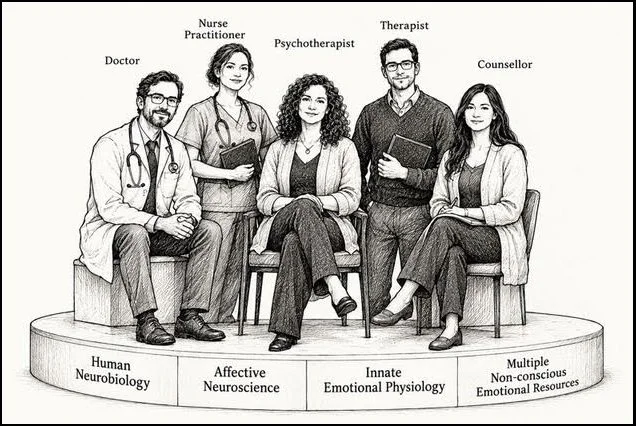
Background: Affective neuroscience.
Affective neuroscience studies the integrations between brain and mind as expressed in the fundamental emotional processes that all mammals share. “Knowledge of the animal brain can help clarify the affective nature of the human mind and how our ability to appreciate the basic emotions of the human mind, [Panksepp 1998]” helps us understand the functional nature of the human mind.
Clinician Emotional Resources Training is derived from the practical application of 25 years of clinical and scientific research that has trained clinicians how to work with their own and their patients’ inherent emotional resources. This training is based on the emotional [affective] neuroscience research of Jaak Panksepp, Antonio Damasio, Richard Davidson, Daniel Siegel, Jeffery Schwartz, Louis Cozolino, Klaus Grawe, Joseph LeDoux, and others. The description and practical application of fundamental emotional resources has been described in the text, Complex Integration of Emotional Brain Systems in Therapy, (2021) Sheldon & Sheldon, New York, Norton.
What makes Affective neuroscience so important? Affective neuroscience harnesses the energies of human neurobiology, intimate relationships and emotional thermodynamics. Each of those factors play the largest roles in our primarily nonconscious emotional learning.
Human neurobiology.
Neuro-Physiological data reveal the activations of multiple nonconscious emotional brain systems [Jaak Panksepp] that are primarily present subcortically in the brainstem, basal nuclei, cerebellum and the peripheral nervous systems. Trainers can use this physiological evidence of emotional neurobiology to treat patients by harnessing their mirror neurons, interoception and nonconscious emotional learning potentials. That empirical information provides diagnostic precision and specificity, which can lead to beneficial treatments in a matter of minutes.
One central part of human neurobiology is the presence of Mirror neurons. Mirror neurons are always processing visual information about the emotions and actions of people in our orbit. They operate out of our awareness, yet they play a major role in the transpiring present moments of our relationships. For example, when my smile and eye gaze reveal my care for you in this moment, your mirror neurons will literally yet nonconsciously experience the authenticity of that care and connection. It is possible for observers to detect the activations of those emotional systems that have been stimulated by the mirror neurons.
Multiple nonconscious Emotional resources.
Recent affective neuroscience and human neurobiology have revealed multiple nonconscious emotional resources also referred to as nonconscious emotional brain systems. These systems operate at four different levels in the nervous system: peripheral nervous system, [examples, lungs, heart and gut] brainstem [Seeking, Play, Safe, Connection, Care systems] basal nuclei [Fear, Shame, Pleasure, Salience systems] and neocortex.
Clinician Emotional Resources Training harnesses all of the above energy, however Clinician Emotional Resources Training does not ask the participants to understand or trust the process. The trainers trust the neurobiology and the Clinician Emotional Resources Training processes. These reflexes are not open for discussion or argument. These neurobiological interventions activate specific reflexes and have been empirically tested hundreds of times. What is powerful is that these interventions activate multiple emotional brain systems. These interventions are based on Affective Neuroscience. Multiple emotional resources and reflexes have evolved over hundreds of thousands of years.
Each of the emotional brain systems generate energy, contain highly evolved wisdom, and processing power..
The spiral on front page of the website is an illustration that reveals multiple brain systems, turbulence, spontaneous activations, repetitions, differentiations, facilitations, integrations, powerhouses, dynamic continuous improvements. The spiral is our practical and clinical application of neurobiology and Complex Integration of Multiple Brain Systems.
Innate emotional physiology
The exercises during the trainings activate, facilitate, and differentiate a range of emotional resources within the participants. With training and practice you can learn how to read the universal innate physiology of 20 distinct emotion brain systems. Those brain systems are, located in the peripheral nervous system, brainstem, basal nuclei, cerebellum and neocortex. You can come to know the unique physiological signatures of each of these emotional resources. That data can also be used to tailor-make the trainings to each group of clinicians. Indeed that data also provides evidence of the present moment success of the exercises.
Clinically Utilizing emotional physiology enables clinicians to harness the mind’s ability to change the the structure of the brain through various forms of neuroplasticity. Observing emotional physiology can enable the clinician to intentionally activate a range of neurotransmitters [dopamine, oxytocin, serotonin and endogenous opioids] for affect/emotional regulation and long-term learning.
Challenges
E. O. Wilson famously said, “The human mind evolved to believe in the gods [tribal cohesion], it did not evolve to believe in biology.”
The intimacy of neurobiology and affective neuroscience is often uncomfortable for some clinicians. The training processes desensitizes clinicians to being vulnerable within themselves. Welcoming the discomfort can be a novel experience.,
It takes time to learn to trust they universal emotional neurobiology especially the roles of the brainstem and peripheral nervous system.
It takes practice to learn to override the constraints of previous psychological and psychotherapeutic training.
It is important to inspire clinicians to keep practicing the exercises with themselves in the mirror, with friends or family members, with their therapists and with each other. Repetition is essential to learning nonconscious emotional skills..
Harnessing the energy of universal adaptive human emotional resources can sometimes uncover nonconscious emotional constraints from previous implicit learning. Those constraints from previous emotional learning can come from unresolved or unknown emotions from early childhood. If constraints are uncovered, it is important to get help from a mentor or therapist. Clinician Emotional Resources Training is not intended to provide therapy or treatment for the participants. However the group process provides excellent care and support when those constraints are uncovered.